Posts

THE DIABETIC PATIENT - PATIENT AND FAMILY TEACHING

Image
Rick has a history of Type2 Diabetes Mellitus. His blood glucose has been high and he has Insulin ordered twice a day. It is midnight and he is requesting his wife brings snacks from home. He has an ankle ulcer and gangrene of the big toe. What would Rick's care plan include? - patient and family teaching - blood glucose monitoring - circulation checks and monitoring of wound healing of the affected foot.  PVD ( Peripheral Vascular Disease may complicate Diabetes Mellitus. Patient and family teaching is very important. Learn more: Can a stroke be prevented? Patient education and misconceptions There are several misconceptions which a diabetic patient may have.   Patient education  is usually included in the plan of care. What are some common diabetic misconceptions ? Some examples of diabetic misconceptions are listed below: - "I do not believe high blood sugar can affect my vision" - "I need new glasses".  Diabetes and high blood sugar can indeed a...

HYPOGLYCEMIA / INSULIN REACTION

Image
  Scenario: Tammy is a 19 year old female who was diagnosed with Type 1 Diabetes a year ago. Today she is scheduled for the OR,  to have a  hernia repair . She has not eaten since midnight.( fasting per MD orders).  The nurse forgot to hold her Insulin as ordered by MD. She gave her 10 units of Regular  Insulin. Tammy is now hypoglycemic. She is feeling weak  and shaky, she calls the nurse. Assessment : The nurse arrived  and did an assessment . She noticed Tammy was anxious  and shaky. She was also diaphoretic (sweating excessively). Intervention: The nurse checked the blood glucose by finger stick and noted a result of 58. She checked the doctor's sliding scale orders and gave Tammy 4oz of apple juice.  She then notified the doctor as ordered and documented her intervention. An example only : See an example of a sliding scale for finger stick values above along with their  suggested treatments. Please not...

DIABETIC MISCONCEPTIONS AND DKA ( DIABETIC KETOACIDOSIS)

Image
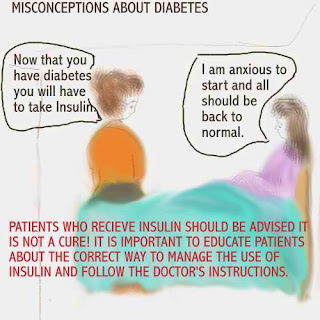
What are some misconceptions about Diabetes? Patients who receive insulin should be advised it is not a cure! It is important  to educate patients about the correct way to manage the use of insulin and follow  the doctor's instructions. There are several misconceptions which a diabetic patient may have. Patient education  is usually included in the plan of care. The image below, is an example of the clinical  picture of the patient in DKA ( Diabetic Ketoacidosis).  For more helpful information,    please click on the link:  DKA    What is DKA? DKA stands for Diabetic Ketoacidosis . Learn more about this topic by clicking on the link: Sessions 41

WHAT IS A CABG?

Image
What is a CABG? CABG stands for Coronary Artery Bypass Graft. It is not a virtual cabbage. CABG (pronounced cabbage) is a surgical procedur e done to improve the heart's circulation in a patient with CAD (coronary artery disease) How is a CABG done? A blood vessel (an artery or vein) is taken from another part of the body and used to reroute blood  (bypass the blocked vessel) to the heart. An artery or vein from the leg or chest is typically used. What are some common symptoms of CAD? Patients who have severe CAD will experience symptoms such as: - Chest pain - Shortness of breath - Dizziness - Hypotension Why do these symptoms occur? This is due to a lack of blood flow in the blood vessels caused by a clot or plaque. The decrease in blood supply results in insufficient oxygen to the heart muscle.   Scenario : Tim was brought to the ER in respiratory distress. He has a previous history of MI and CHF. He also had a CABG done 1 ye...

DEHYDRATION AND A LONG FLIGHT

Image
  Most people who anticipate taking a long plane  flight may hardly stop to think about dehydration  and its consequences.   Making sure adequate clothing is packed, arriving at the airport on time, and making sure pets or children are cared for, are just a few of the concerns  a traveler might have. Skipping a meal as a result of  anxiety may very readily happen. To further complicate matters, there are significant changes in time zones on a long flight across the globe. Someone who has been on a long flight and sitting for a considerable length of time, coupled with inadequate fluid intake, may be at risk for DVT (Deep Vein Thrombosis) . It is worth noting that taking the time to drink extra fluids before and during a long flight, will help prevent dehydration. To learn more about Dehydration, you can watch a video here . For more helpful information: Dehydration for the layperson. Learn more about :  ARDS, DVT and PE Learn more ...

ASPIRATION PNEUMONIA AND PREVENTION

Image
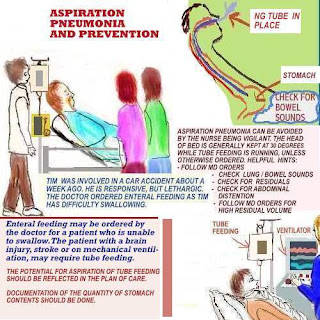
Scenario : Tim was involved in a car accident about a week ago. He is responsive but lethargic. The doctor ordered enteral feeding as Tim has difficulty swallowing. Why is enteral feeding ordered? Enteral feeding may be ordered by the doctor for a patient who is unable to swallow. The patient with a brain injury, stroke, or  on mechanical ventilation may require tube feeding. How can aspiration pneumonia be avoided? Aspiration pneumonia can be avoided by the nurse being vigilant. The head of the bed is generally kept at 30 degrees while tube feeding is running unless otherwise ordered. Enjoy watching the videos: Sessions 44- The patient on mechanical ventilation Nursing Fundamentals Helpful Hints: - Follow MD orders - Check lung/bowel sounds - Check for residuals - Check abdominal distention - Follow MD orders for high residual volume Notes for Nurses : - The potential for aspiration of tube feeding should be reflected  in the plan of care. - Documentat...

AN OVERVIEW OF PACEMAKERS

Image
The SA   (sinoatrial) node is the pacemaker of the  heart and is part of the electrical conduction system. Learn more about: Addressing pacemaker insertion Why is a pacemaker implanted? Pacemaker implantation may be done for different reasons . Any damage to the heart muscle or the electrical conduction which will interfere with the ability of the heart to function normally may be indications for a pacemaker. Sick sinus syndrome (though rare) or myocardial infarction are examples. Symptoms of a dysfunctional natural pacemaker Patients who have dysfunction of their own natural pacemaker may experience dizziness , syncopal episodes (temporary loss of consciousness), chest pain,  shortness of breath, fatigue, and a decrease in blood pressure (hypotension). These symptoms are due to a lack of blood flow to the body's organs. The image above shows an EKG with a pacemaker lead (wire) in the ventricle. There is normally a spike  in front of the QRS.  The spik...