Posts

Showing posts matching the search for AAA

RECOGNIZING HYPOVOLEMIC SHOCK
Image
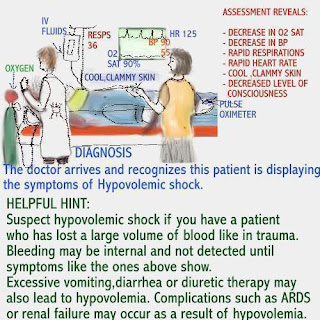
  The clinical  scenario above shows a patient who has arrived in the ER following a traumatic event. The doctor arrives and recognizes the patient is in hypovolemic shock . When an assessment is done, suspect hypovolemic shock if there has been a large volume of blood loss following trauma.  Warning signs - decrease in oxygen saturation, blood pressure or    level of consciousness - rapid respirations or heart rate - cool, clammy skin Complications such as ARDS  or renal failure may occur as a result of hypovolemia. Learn more about this topic, by clicking on the link: AAA              Aortic rupture   may occur as a result of  trauma. Shortness of breath ,  chest or upper back pain are some of the symptoms. Cardiac Tamponade may be caused by penetrating  trauma   such as a knife wound. Pericardiocentesis is usually done to remove the  blood   in the pericardial sac. Learn mor...
HELPFUL INFORMATION ABOUT AN AORTIC ABDOMINAL ANEURYSM

Image
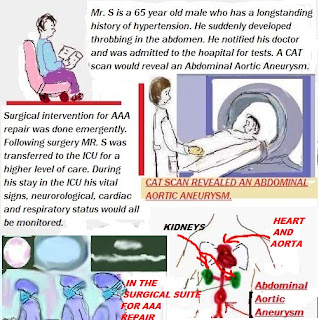
  Scenario : Mr. S is an elderly male who has a longstanding history of hypertension. He suddenly develops throbbing  pain in the abdomen. He notified his doctor and was admitted to the hospital for tests. A CAT scan would reveal an  Abdominal Aortic Aneurysm. Surgical intervention for AAA was done emergently. Following surgery, Mr.S was transferred to the ICU  for a higher level of care. During his stay, his vital  signs, neurological, cardiac and respiratory status   would all be monitored. Please click on the links for more learning: Hemodynamic Monitoring Info for the layperson Scenario : Mr.S had a repair of an Abdominal Aortic Aneurysm done. He  will be cared for and  closely monitored  in the ICU. Please click on the link below, for more information. Mr. S in the ICU.    What is an aneurysm? An aneurysm is a ballooning or bulging in a  blood  vessel. Aneurysms may occur in the brain or the abdomen  (the aort...