Posts

SIMPLE FACTS ABOUT HYPOVOLEMIC SHOCK

Image
The patient in Hypovolemic Shock The patient in Hypovolemic Shock has usually lost a significant amount of blood. Fluid replacement and  assessment is necessary. IV fluids such as Ringers Lactate, Albumin or blood transfusion may be used in the treatment. Enjoy watching the videos : Sessions for Nurses 9 - The Patient in Hypovolemic or Spinal Shock The New Nurse - Blood transfusion Blood transfusion reaction: If a blood transfusion is ordered by the doctor, it is important for the nurse torememb er that a reaction is possible. There are many steps to follow, in order to ensure that the blood transfusion is done correctly .  The nurse should also bear in mind , the possibility of a blood transfusion reaction, even when things are done the right way. Warning signs of a blood transfusion reaction: -  chills, anxiety, flushing - itching, shortness of breath, chest pain Immediate action should be taken, to stop the blood and notify MD for further orders.

A CARDIOPULMONARY ARREST - QUIZ QUESTIONS

Image
               A Code Blue in progress The scenario above, shows several staff members around the bedside of    a  patient in cardiopulmonary arrest, in the ICU. However , this can occur                 anywhere. Trained staff are usually assigned to follow ACLS guidelines  in such a situation. CPR is started by the staff. Learn more by watching the video: The New Nurse- Assessment  Heart attack for the layperson Cardiopulmonary arrest is called a Code Blue. This means the heart has stopped beating and the body's cells are deprived of blood supply and oxygen. Immediate action is taken by the staff , to call a Code Blue overhead. This summons trained personnel to that patient's bedside. Without a doubt, everything is chaotic. A crash cart which contains medications ,               syringes, suctioning equipment, a defibrillator, IV solu...

SIMPLE BRAIN FACTS -NURSES DID YOU KNOW?

Image
The brain is protected by the skull. Injury to the brain may result in swelling. The skull is made of solid bone and the brain has no room to expand when swelling occurs. ICP Monitoring is done to reduce swelling and monitor brain pressures. The brain injured patient is at risk for seizures.  This should be reflected in the plan of care . Learn more, by watching the videos: ICP monitoring The brain injured patient Learn more about : Communication skills

ATROPINE AND TPN - HOW USED IN THE CLINICAL SETTING

Image
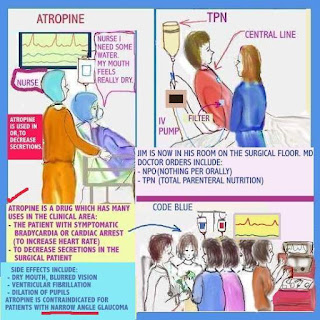
Scenario : In the image above, Jim had surgical intervention and is  transferred to PACU post surgery. He complains of a dry mouth. This is not uncommon after having Atropine. Atropine and its uses: Atropine is a drug which has many uses in the clinical setting. For example, it is used for: - the patient with symptomatic bradycardia , to increase heart rate - to decrease secretions in the surgical patient Side effects : There are side effects such as: dry mouth, blurred vision , dilated pupils and more. TPN and its uses: What does TPN mean? TPN means Total Parenteral Nutrition. This is a form of nutrition which is given by intravenously, via a Central line. It is given to patients who cannot eat or drink. Learn more about TPN and how it is administered. Just click on the link : Sessions 20 Learn about :  the ABG  and Code Blue Learn more about :  The Circulatory System Scenario:  The patient above, was in  respiratory distress and placed  on ...

UNDERSTANDING THE ROLE OF THE TRIAGE NURSE

Image
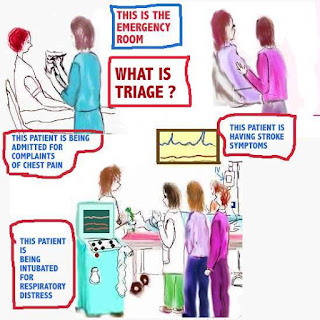
In the image above, there are three different scenarios. 1) A patient is having complaints of chest pain . 2) A patient is having stroke symptoms. 3) A patient is being intubated for respiratory distress. What is the role of the Triage nurse?   The Triage nurse has the responsibility of prioritizing which patient is critical and needs immediate attention when working in the ER. Each scenario tells its own story. Enjoy watching the video: Triage nurse  for more information. In this Emergency Room scenario, a patient has been transported to the ER. Medical staff members are gathered around the bedside.   It takes "all hands on deck" to complete the work. It is important to recognize that classroom skills are different from  clinical skills . A nurse's performance in the work place takes on a different  challenge from the classroom. Trauma can sometimes be prevented!

AN OVERVIEW OF ANASARCA - QUIZ QUESTIONS

Image
The image above shows the clinical picture of the patient with Anasarca. Anasarca and its causes Anasarca, which is also known as generalised edema, may be caused by a number of conditions. These include: - Heart, renal or liver failure - Low albumin (hypoalbuminemia), burns - Corticosteroids and more The treatment is directed at the cause: - The patient in renal failure may require hemodialysis. - Liver failure may call for long and aggressive treatment.  Fluid restriction, diuretics, dietary changes (like sodium restriction),  and daily weights may be ordered by the doctor. - The patient with hypoalbuminemia will need IV albumin replacements. Lab values are also necessary, to monitor an  improvement in the albumin levels or sodium levels. Also enjoy watching the video: Sessions 46- Assessment QUIZ QUESTIONS 1) What is anasarca also known as? 2) Name some of the causes? 3) How is this condition treated? 4) What is hemodialysis? Please watch the vid...

ADDRESSING IV THERAPY AND BLOOD TRANSFUSION /REACTION

Image
There are numerous reasons a patient may require IV therapy. Examples:                                            1) The patient who was involved in a trauma event and unable to take fluids by mouth.                                                                                                                                              2) The patient who is having surgical intervention and has been ordered                       NPO ( nothing per orally), by the do...