Posts

HEART SMART - SIMPLE FACTS
Image
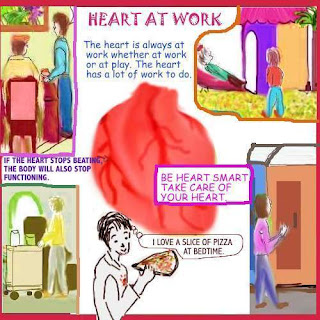
The heart is always at work. Even though this organ is about the size of a folded fist, it has a tremendous amount of work to do.  The heart never stops beating. If the heart stops beating, the body will not be able to function. Simple advice - be heart smart! Avoid rich foods late at night, as digestion is slow and the heart may not be able to cope with the increased workload. Please click on the link for more learning:   The New Nurse-Hemodynamic monitoring  

WHAT HAPPENS AFTER A STROKE ?

Image
      What happens after a stroke? The above image gives some insight following a stroke . The occipital lobe in the brain, lies in the posterior part of the brain. This area is responsible for vision.  The scenario above shows Sam had a stroke affecting his occipital lobe and became vision impaired. Following a stroke. an eye exam may become necessary to check for visual acuity. Another scenario : Tina's stroke involved the parietal lobe. She is having trouble distinguishing right from left and doing math calculation. Stereognosis - the normal ability to identify objects by touching. Learn more about : Care planning  Learn more about : The cranial nerves

CASE STUDY CONCLUSION

Image
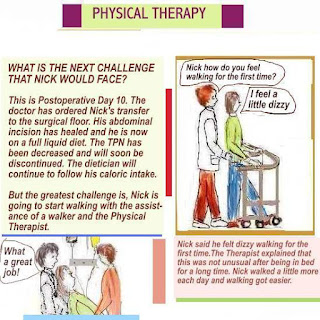
  Case study conclusion: Dear nurses, This case study begins here: Trauma / Sepsis case study  and continues here: Trauma/Sepsis  This overview of a case study now draws to a conclusion. Nick was transferred to the postoperative floor on Day 10. His abdominal incision is completely healed  and he has been placed on a regular diet. The TPN has been decreased and soon to be discontinued. Physical Therapy : Nick will soon be walking with supervision from a physical therapist . In the image above, Mrs.M sustained a fracture of the neck of the femur. An ORIF ( open reduction internal fixation) was done in the  Operating Room . Learn more about: The importance of Therapy Learn more about : Spinal Cord Injury

HAVE A GOOD WEEK - THERE IS A LOT TO LEARN!

Image
Updated 11/25 Have a good week! Enjoy learning something new. Lots of topics below! Learn more about :  Critical thinking Common causes of medication errors Clinical scenarios are a normal part of nursing. Above there are five  clinical scenarios  unfolding. Scenario 1 - A patient who is admittCed to a healthcare facility and will need teaching. Click on the link: ER experience for the layperson Scenario 2 - The patient on mechanical ventilation and the nurse is unsure what to do.Click on the link:    The patient on mechanical ventilation Scenario 3  -A patient has arrived in the Emergency Room, both the doctor and nurse are at the bedside to do an assessment. Learn more by clicking on the link: An ER experience   Scenario 4  - A nurse does an assessment. Click on the links: IV assessment An arterial line Scenario 5  - A nurse tries to encourage a patient to do breathing exercises. Click on the link: Care planning

TRAUMA/SEPSIS CASE STUDY CONTINUES

Image
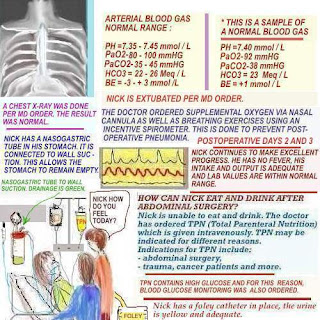
The Sepsis case study begins: Here The image above provides helpful information about Nick's progress in the ICU.  The day following  admission continues below: Postoperative day 1  - extubation ( his endotracheal tube was removed ) was done.Prior to removal of the endotracheal tube, an ABG was done. Results can be seen above. Supplemental oxygen via nasal cannula was done.To learn more about Mechanical Ventilation please click on the link and enjoy learning: Mechanical Ventilation Postoperative days 2 and 3: Nick continues to make excellent progress. He is afebrile. His lab values are within normal limits. He also has a nasogastric tube which is connected to wall suction. Why was TPN ordered for Nick? Total Parenteral Nutrition (TPN) was ordered by the doctor, as Nick would not be able to eat and drink as normal. Adequate nutrition would be provided via TPN. A central line and  special IV tubing with a filter, is used. What is septic shock? The image above sh...

NURSING FROM OLD TO NEW

Image
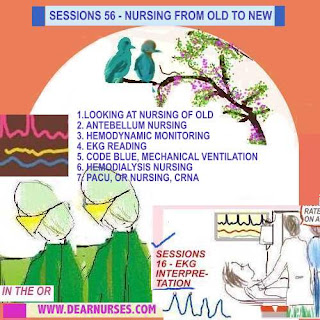
                    The website on the image above is no longer available. There is always room for growth in our profession. However, there is more helpful information which can be accessed by clicking on the link: Sessions 69 and mor e The standards of care are an essential part of  the Nursing profession. It provides  guidelines  within a framework of practices. Learn more about :  The standards of care Learn more about :  Nursing communication PCA ( Patient Controlled Analgesia) Patient Controlled Analgesia  may be ordered by the doctor for the patient who is awake, alert and able to self medicate. This method of administering pain medication , is done via a pump, through the intravenous route. Dosages are decided by the doctor. However, patient and  family   teaching should be included in the  care plan.   It is not uncommon for family members to press the pain button for the pa...

SEPSIS AN OVERVIEW( WHAT IS SEPTIC SHOCK?) / QUIZ QUESTIONS

Image
 WHAT IS SEPTIC SHOCK? Septic shock is a condition which is commonly seen in the ICU. It is suggested that the long and complicated course of illness in ICU patients , may contribute to sepsis. Organisms such as gram negative rods, enter the bloodstream and trigger an inflammatory process. PHASES OF SEPTIC SHOCK  Septic shock is divided into two phases. The hyperdynamic ( warm phase)and the hypodynamic ( cold phase). If treated early, sepsis may not progress to the cold phase. Please read the image and learn more. Nick was fortunate. The possible septic event was mild and responded to antibiotic therapy. His abdominal incision showed signs of improvement and Nick made a full recovery. Updated 4/23  Be aware, that there have been changes made in the treatment  of Sepsis . It is suggested that broad-spectrum antibiotics are used. Medications used currently, are antibiotics such as Piperacillin and Ceftriaxone. Also watching the video: The New Nurse- Diagnostics QUIZ ...