Posts

POTENTIAL PROBLEMS OF THE PATIENT ON MECHANICAL VENRILATION

Image
Scenario : John was admitted to the ICU with difficulty breathing .He was intubated and placed on mechanical ventilation. Potential problems of the patient on mechanical ventilation: 1. Anxiety related to intubation. Typically, medication to decrease   anxiety is ordered by the doctor. 2. Impaired gas exchange . Maintaining a patent airway is  very important. Checking breath sounds, suctioning secretions and troubleshooting alarms, are actions taken.  3. Self extubation   may occur, so for this reason, the doctor may order restraints or some other option to prevent this happening. 4. Water might collect in the tubing of the ventilator. Measures to clear the tubing is usually done. Patient and family education Patient and family education will help to decrease anxiety. Patient restraints may be necessary to prevent self extubation. Learn more: Stress  CARE PLANNING The nurse is responsible for evaluation and documentation of patient progress based on the ...

UNDERSTANDING THE STANDARDS OF CARE

Image
  ABOUT THE STANDARDS OF CARE The standards of care are an essential part of  the Nursing profession. It provides guidelines within a framework of practices. Inservice education provides a platform for staff members  to be educated regarding a safe work environment. Each institution has policies and procedures in place that are demonstrated as needed , in order to maintain a good standard of care. Inservice education is set up to enforce the standard of care and updates are usually done to improve this standard. Maintaining and providing safe work practices, is a must. What has not changed? Some things never change. Let us take a look: 1.The heart still has four chambers and pumps blood all around the body. 2. The brain is made up of four lobes and has twelve cranial nerves. 3. There are right and left lungs which oxygenate blood. 4. Insulin is secreted by special cells in the pancreas. How can we improve? It is important to recognize that classroom skills  ar...

ADDRESSING CATATONIC SCHIZOPHRENIA

Image
Scenario : In the image above, there are two people with catatonic schizophrenia. Jan on the left , has been standing in the same position for many hours. She has not been speaking. Ann on the right, has been having long periods of sitting and staring blankly, as well as neglecting her personal hygiene.   The cause of this condition is not fully understood. Both are displaying signs and symptoms of catatonic schizophrenia. These include : - immobility or not speaking for long periods of time - neglecting personal hygiene - making statements that make no sense Treatment of schizophrenia is discussed.    What is an avalanche? An avalanche as we know it , is a rapidly moving mass of  snow  or  other material along a mountain slope. Learn more about : Natural disasters

UNDERSTANDING THE MRI ( MAGNETIC RESONANCE IMAGING) AND PREPARATION

Image
 In the image above, someone is scheduled for an MRI. What is an MRI? An MRI ( Magnetic Resonance Imaging) is a diagnostic study. It is noninvasive. MRI scans have the ability to show bones, blood vessels and other internal structures. MRI has very strong magnetic fields. Preparation for an MRI scan  When an MRI scan is ordered by the doctor, special preparation is made. Because of the strong magnetic fields, a questionnaire is filled out. Knowledge regarding pacemaker insertion , IVC filter, aneurysm clips , surgical wires and more is documented. Objects such as keys, credit cards,   coins and glasses are removed. An MRI scanner may be very noisy, like a blow horn. The doctor may  order sedation for the patient who has claustrophobia .  Patient education is also done . The result of the MRI scan will be read by the doctor. Preparation for ERCP (Cholangiopancreatography) Learn more:  What is an ERCP?

IDENTIFYING THE NEED FOR THE CAT SCAN

Image
In the image above, Tracy was practicing for show jumping. She fell off her horse and had to be transported to the Emergency Room by paramedics. She did not lose consciousness, but did have a mild headache. The doctor ordered a CAT SCAN of the head, to find out if there is any internal bleeding. What is a CAT SCAN? CAT SCAN ( Computerized Axial Tomography) A CAT SCAN is a type of X Ray used to scan body parts in detail.  It is noninvasive and can show parts of the body like muscles, bones, organs and more. When a CAT Scan is ordered by the doctor , the nurse is responsible  for a consent being signed by the patient or guardian. Contrast dye is sometimes used and may be given orally or IV. The doctor decides whether to use dye. Sedation may be ordered by the doctor, to decrease anxiety. Once the CAT scan is completed, the doctor will read the scan and  confirm diagnosis. Here are some diagnostic tests that are done frequently. Follow the links below: 1.  Ches...

VASOSPASM AFTER SUBARACHNOID HEMORRHAGE

Image
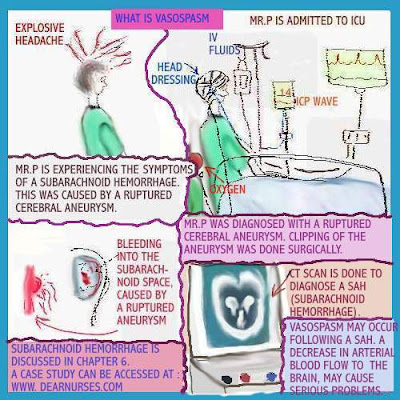
  Subarachnoid Hemorrhage   The image above shows a patient displaying the symptoms of Subarachnoid  hemorrhage. A CAT scan  was done to confirm the diagnosis.   Surgical intervention was done, for clipping of the aneurysm. He will be cared for in the ICU. VASOSPASM  This condition may occur following a Subarachnoid hemorrhage. TCD ( Transcranial Doppler) ultrasound is ordered by the doctor, following a Subarachnoid hemorrhage. This is a noninvasive study to evaluate    blood flow in the brain.   The consequences of poor circulation Poor circulation   may occur for a number of reasons. Any obstruction to the flow of blood may lead to conditions such as stroke,  heart failure , and or  renal failure  .The  diabetetic  patient is also at risk. What is a stroke? A stroke is also known as a brain attack. Reperfusion Therapy  is a form of treatment that is used for patients who have a myocardial infarction...

BRUDZINSKI'S AND KERNIG'S SIGNS

Image
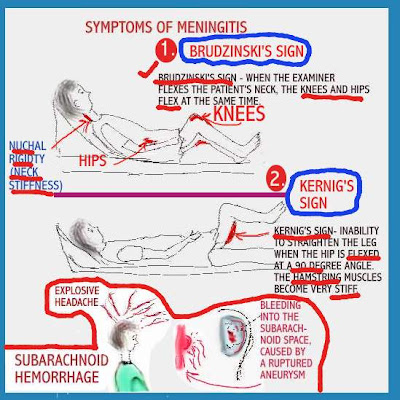
Brudzinski's and Kernig's signs  are seen in patients who have Meningitis or  Subarachnoid hemorrhage. Brudzinski's sign  -When the examiner flexes the patient's neck , the knees and  hips flex at the same time. Kernig's sign  - inability to straighten the leg when the  hip is flexed at a 90 degree  angle. The hamstring muscles become very stiff.  Medical abbreviations - Part 2 Learn more about : Stroke and ICP Monitoring