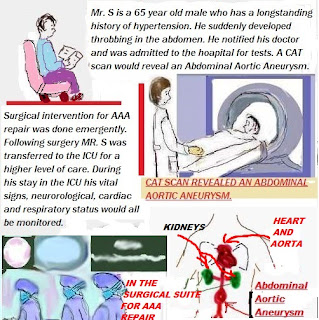
Scenario : Mr. S is an elderly male who has a longstanding history of hypertension. He suddenly develops throbbing pain in the abdomen. He notified his doctor and was admitted to the hospital for tests. A CAT scan would reveal an Abdominal Aortic Aneurysm. Surgical intervention for AAA was done emergently. Following surgery, Mr.S was transferred to the ICU for a higher level of care. During his stay, his vital signs, neurological, cardiac and respiratory status would all be monitored. Please click on the links for more learning: Hemodynamic Monitoring Info for the layperson Scenario : Mr.S had a repair of an Abdominal Aortic Aneurysm done. He will be cared for and closely monitored in the ICU. Please click on the link below, for more information. Mr. S in the ICU. What is an aneurysm? An aneurysm is a ballooning or bulging in a blood vessel. Aneurysms may occur in the brain or the abdomen (the aort...
In the image above, Mr. R is admitted to the hospital with a history of congestive heart failure. His doctor has ordered a fluid restriction of 500 cc/day, per orally. There are medical conditions that may require fluid restriction as part of the treatment. Here are some examples: Liver failure , heart failure, kidney failure . Please read the image above for the specific amount of fluids that were allowed and the amount of fluids he consumed. The decimal approach is used. Learn more: Congestive heart failure The Clinical setting step by step is no longer available. Liver failure may be acute or chronic. Causes include: certain drugs, alcohol abuse and certain chemicals. Learn more about: Hepatic Encephalopathy Learn more about Liver and kidney failure Common causes of medication errors
The image above shows the clinical picture of the patient with Anasarca. Anasarca and its causes Anasarca, which is also known as generalised edema, may be caused by a number of conditions. These include: - Heart, renal or liver failure - Low albumin (hypoalbuminemia), burns - Corticosteroids and more The treatment is directed at the cause: - The patient in renal failure may require hemodialysis. - Liver failure may call for long and aggressive treatment. Fluid restriction, diuretics, dietary changes (like sodium restriction), and daily weights may be ordered by the doctor. - The patient with hypoalbuminemia will need IV albumin replacements. Lab values are also necessary, to monitor an improvement in the albumin levels or sodium levels. Also enjoy watching the video: Sessions 46- Assessment QUIZ QUESTIONS 1) What is anasarca also known as? 2) Name some of the causes? 3) How is this condition treated? 4) What is hemodialysis? Please watch the vid...



Comments
Post a Comment