Posts

Showing posts matching the search for liver failure

LIVER FAILURE AND RENAL FAILURE- QUIZ QUESTIONS

Image
The patient with cirrhosis of the liver Scenario: Mr.X was admitted to the hospital with a diagnosis of liver failure. He is awake, but lethargic. His abdomen is distended ( ascites) and his foley catheter has low urinary output, which is tea colored. He is short of breath and the doctor has ordered oxygen via nasal cannula. Mr.X's ammonia level  is high due to liver failure. Lactulose ( po) has been ordered by the doctor. The patient in liver failure may develop hepatic encephalopathy. This results in altered mental status and possible coma. This may be an indication for ICP  monitoring.                       THE LIVER The liver is the largest organ in the body. It lies in the right, upper quadrant  of the abdomen. It's functions include: - detoxifies harmful substances and stores glycogen, vitamins and minerals - metabolizes protein and carbohydrates - produces and excretes bile which is used to emulsify fats, tu...
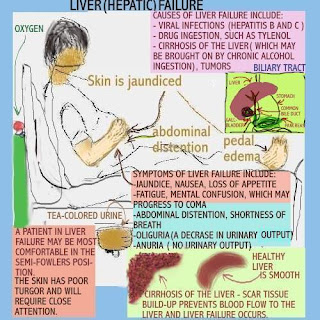
LIVER (HEPATIC ) FAILURE AND PARACENTESIS - QUIZ QUESTIONS

Image
6/25 Cirrhosis of the liver Cirrhosis of the liver is caused by scar tissue build-up on the liver, (often caused by chronic alcohol or drug ingestion). This  prevents  blood flow  to the liver and causes liver failure to occur. A  healthy  liver is normally smooth. Causes of liver failure - Viral infections (such as Hepatitis B and C) - Drug ingestion (such as Tylenol) - Cirrhosis of the liver* (which may be brought   on by chronic alcohol/drug ingestion) - Tumors Signs and symptoms of liver failure - Jaundice, nausea, loss of appetite - Fatigue, mental confusion (which may progress to a coma ) - Abdominal distention, shortness of breath - Pedal edema - Tea-colored urine - Oliguria (a decrease in urinary output) - Anuria (no urinary output) Anasarca ( generalised edema) may lead to skin breakdown . The skin has poor turgor and will require close attention. Ammonia and other toxins, may travel to the brain, via th...

HEPATIC ENCEPHALOPATHY - QUIZ QUESTIONS

Image
The Clinical setting step by step is no longer available. Liver failure may be acute or chronic.  Causes include: certain drugs, alcohol  abuse and certain chemicals . Hepatic Encephalopathy Hepatic Encephalopathy is a complication  of liver failure. The damaged liver loses  the ability to remove ammonia and other toxic waste.These products build up in the  blood and can migrate to the brain, resulting in  encephalopathy.   Patients may become  confused , lethargic  and even comatose.  Typically, Lactulose is ordered by the doctor,  to remove excess  ammonia. ICP monitoring is sometimes  done for the patient with  hepatic encephalopathy.                                                                              ...

LIVER FAILURE- QUIZ QUESTIONS

Image
Cirrhosis of the liver Liver failure may be acute or chronic. Causes include : ingestion of certain drugs, alcohol abuse or other chemicals. Signs of liver failure  The liver becomes enlarged in cirrhosis. The abdomen  becomes distended ( ascites) and spider veins cover the abdomen. Liver failure may progress over a few days or over a long period of time.                                                Learn more by clicking on the link: Liver transplant QUIZ QUESTIONS 1) What is cirrhosis of the liver?   2) What are some signs of liver failure? 3) What is ascites? Above is a 35 year old female who has been having problems after a divorce.  Alcohol ingestion in large quantities has become a way of  coping . This is not a case study, but an example of how pancreatitis and autodigestion may come about.  ARDS may also result. Learn more abou...

UNDERSTANDING FLUID RESTRICTION IN THE CLINICAL SETTING

Image
  In the image above, Mr. R is admitted to the hospital with a history of congestive   heart failure. His doctor has ordered a fluid restriction of 500 cc/day, per orally. There are medical conditions that may require fluid  restriction as part of the treatment. Here are some examples: Liver failure , heart failure, kidney failure . Please read the image above for the specific amount  of fluids that were allowed and the amount of fluids  he consumed.  The decimal approach is used. Learn more: Congestive heart failure The Clinical setting step by step is no longer available. Liver failure may be acute or chronic. Causes include: certain drugs, alcohol abuse and certain chemicals. Learn more about: Hepatic Encephalopathy Learn more about  Liver and kidney failure Common causes of medication errors

LIVER FAILURE AND PARACENTESIS / POTENTIAL PROBLEMS/ CARE PLANNING

Image
  Paracentesis In the image above , a patient is being examined by his doctor. He has an enlarged abdomen due to liver  failure. He is also experiencing shortness of breath . The patient in  liver   failure, may experience difficulty breathing. This is caused by an accumulation of peritoneal fluid in the abdominal   cavity. Paracentesis is done to remove excess fluid and make  breathing easier. The Care Plan would reflect the potential problems associated with this condition. This would include: - Respiratory problems related to ascites. -  Skin breakdown  related to  anasarca . - M ental confusion  related to liver toxins. -Decrease in  urinary output  related to liver failure. Learn more about : P otential problems and   Care planning and The Digestive System Here are some diagnostic tests that are done frequently. Follow the links below: 1.  Chest X ray 2.  CAT scan 3.  EKG 4.  MRI scan 5....

AN OVERVIEW OF ANASARCA - QUIZ QUESTIONS

Image
The image above shows the clinical picture of the patient with Anasarca. Anasarca and its causes Anasarca, which is also known as generalised edema, may be caused by a number of conditions. These include: - Heart, renal or liver failure - Low albumin (hypoalbuminemia), burns - Corticosteroids and more The treatment is directed at the cause: - The patient in renal failure may require hemodialysis. - Liver failure may call for long and aggressive treatment.  Fluid restriction, diuretics, dietary changes (like sodium restriction),  and daily weights may be ordered by the doctor. - The patient with hypoalbuminemia will need IV albumin replacements. Lab values are also necessary, to monitor an  improvement in the albumin levels or sodium levels. Also enjoy watching the video: Sessions 46- Assessment QUIZ QUESTIONS 1) What is anasarca also known as? 2) Name some of the causes? 3) How is this condition treated? 4) What is hemodialysis? Please watch the vid...

ADDRESSING HEMODYALISIS AND QUIZ QUESTIONS

Image
Hemodialysis Hemodialysis is a form of treatment for the patient in renal failure. This may occur for a number of reasons. Whatever the cause, hemodialysis may be used for a long or short period of time. Kidney function The kidneys filter out waste products from the blood. This is passed out as urine . The kidneys are located in the abdominal cavity and are bean shaped. Causes of renal failure Possible causes of renal failure may include: - Diabetes Mellitus, pancreatitis - Trauma, liver failure, and more The kidneys  are part of the excretory system. If they are unable to perform their  normal functions , renal failure may result. 1) What is Hemodialysis? 2)  What is the function of the kidneys? 3)  What are some causes of renal failure? 4)  Which body system are the kidneys part of?

ADDRESSING CONGESTIVE HEART FAILURE

Image
In CCU                      The image above shows Mrs. R, is admitted to the CCU with            complaints of chest pain . Her past medical  history includes              two heart attacks. She calls the nurse, as she is experiencing              extreme shortness of breath .The nurse does an assessment,             checks vital signs and applies oxygen, she documents her findings. ( See image)    The nurse notifies the doctor regarding Mrs.R's condition.   Following an examination, the doctor decides to run some         tests. The EKG shows an anterior wall myocardial infarction.   The cause of an anterior wall MI, is obstruction to the flow  of blood in the LAD  (left anterior descending) artery. This       obstruc...

ADDRESSING ERCP AND CHOLECYSTECTOMY

Image
Scenario:  Pam has been admitted to the hospital with complaints of  abdominal pain  over a period of time. The doctor has decided to do an ERCP ( Endoscopic Retrograde Cholangiopancreatography) for this questionable abdominal pain. This will be reflected in the  care plan. In the event of a diagnosis of gallbladder disease , a cholecystectomy may be ordered by the doctor. This is a surgical   procedure to remove the gallbladder. The organ is part of the digestive system . The gallbladder is responsible for storing bile, which is produced by the liver. Bile helps in the digestion of fats. The most common cause of gallbladder inflammation (cholecystitis) is gallstones. Sometimes, cancer may also be the cause of this problem. Sharp abdominal pain after ingestion of food, nausea and vomiting, are classic symptoms. Family teaching  is also necessary Preparation for ERCP (Cholangiopancreatography) Learn more:  What is an ERCP? In the image above , a patie...

WHAT ARE THE KIDNEYS ?

Image
Scenario 1 : Mrs. S is a 38 year old female who has just been diagnosed with renal failure. The doctor discusses hemodialysis to improve the situation . What are the kidneys? The kidneys are two bean-shaped organs located in the  abdominal cavity on either side of the spine. They work to filter out waste products from the blood.   Scenario 2 : Tim was diagnosed with acute renal failure. A decrease in urinary output and recent antibiotic therapy were some of the factors that confirmed his diagnosis. Hemodialysis is ordered by the doctor. Special trained staff follow instructions ordered by the doctor. A nurse carries out the treatment ordered and monitors the patient during hemodialysis. What is renal failure? Renal failure occurs when the kidneys are no longer able to  perform their normal function and unable to filter the blood.  Depending on the cause, renal failure may be acute or chronic. Enjoy watching he video: The New Nurse - liver and...

AN OVERVIEW OF THE KIDNEYS

Image
  The clinical scenario above shows a 38 year old female who has just been diagnosed with renal failure. THE KIDNEYS ( an overview) The kidneys are two bean shaped organs located in the abdominal cavity on either side of the spine. They work to filter out waste products from the blood. If the kidneys fail, hemodialysis is ordered by the doctor,  in an attempt to remove waste products. Depending on  the situation , this may be short or long term. Learn more by clicking on the link : Hemodialysis Learn more about :  Organ failure and transplantation Anasarca and its causes Anasarca , which is also known as generalised edema, may be caused by a  number of conditions.  These include: - Heart, renal or liver failure - Low albumin (hypoalbuminemia), burns - Corticosteroids and more This topic, including quiz questions, continues here: Anasarca  The Braden Scale is used for predicting pressure ulcers.These may develop in patients who are  confined ...

IDENTIFYING PARANOID SCHIZOPHRENIA

Image
Scenario : The young lady in the red shirt is  traveling on a bus.She is having delusions.  She feels certain she is hearing voices telling                               her that other passengers on the bus are plotting                              to harm her.                                                                       Signs and symptoms of paranoid schizophrenia                          include : delusions , anxiety,   auditory hallucinations  and suicide ideation.     AN OVERVIEW Paranoid Schizophrenia is a mental disorder which is identified as the m...

CLINICAL APPEARANCE OF THE PATIENT IN DKA - QUIZ QUESTIONS

Image
  Clinical appearance of the patient in DKA Scenario : Tom was admitted to  the ICU , with the clinical picture of a patient in diabetic ketoacidosis (DKA). His blood glucose was 600. Tom has an altered level of consciousness (LOC). He also has hyperglycemia (elevated blood glucose). Please watch the video below: Dehydration Signs and symptoms of DKA The patient in DKA requires  immediate intervention  and a level  of care like ICU. Some signs that may appear includ e: - Hyperglycemia - Tachycardia (rapid heart rate) - Tachypnea (rapid breathing) - Polyuria ( excessive urination) - Polydipsia (excessive thirst) - Flushed face - Breath has a fruity odor Please enjoy the video: Patient education Medical management is necessary for the patient in DKA. Frequent monitoring of blood glucose, Insulin IV, Potassium replacements are included in the management. Learn more: Sessions 68-Quiz QUIZ QUESTIONS 1) What are some of the signs of a patient in DKA? 2) How is DKA man...